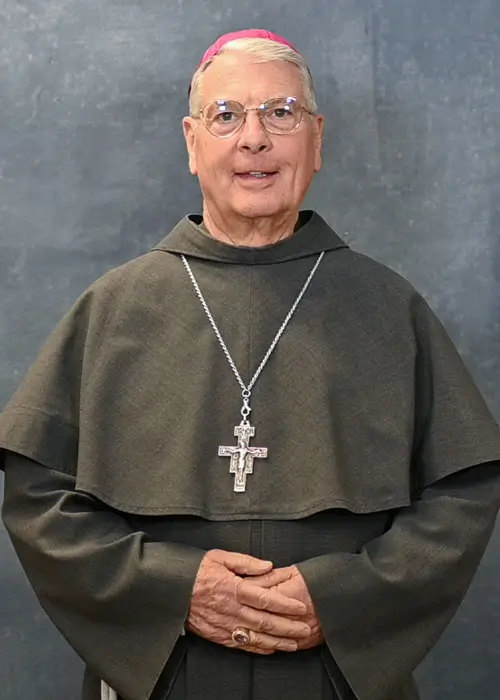
Archbishop Gregory J. Hartmayer, OFM Conv.
Gregory Hartmayer, OFM, Conv. is the seventh Archbishop of Atlanta. He was installed on May 6, 2020.
His served as pastor of St. Philip Benizi Church in Jonesboro from 1995-2010, and pastor of St. John Vianney Church in Lithia Springs in the Atlanta Archdiocese before being ordained the 14th Bishop of Savannah in 2011, by Pope Benedict XIV.
He currently serves on various local and national committees as he oversees the growth of the local archdiocese serving 1.2 million Catholics throughout north and central Georgia.
Biography
Archbishop Hartmayer, son of the late John and Sally Hartmayer, was born on November 21, 1951 in Buffalo, New York. Raised in Tonawanda, New York, a northern suburb of Buffalo, he was a member of St. Amelia Catholic Church, where he attended elementary school.
After graduating from St. Amelia Elementary School, Archbishop Hartmayer attended Cardinal O’Hara High School, conducted by the Conventual Franciscan Friars and graduated in 1969. Upon graduation, he joined the Conventual Franciscan Friars at their Novitiate of St. Joseph Cupertino in Ellicott City, Maryland. He professed his simple vows there on August 15, 1970.
Archbishop Hartmayer then pursued studies at St. Hyacinth College and Seminary in Granby, Massachusetts, from which he received a bachelor of arts degree in philosophy in 1974. Meanwhile, he professed his solemn vows as a Conventual Franciscan Friar on August 15, 1973.
After graduating from college, Archbishop Hartmayer was assigned to teach at Archbishop Curley High School in Baltimore, Maryland, from 1974 through 1975. He then entered theological studies at St. Anthony-on-Hudson Seminary in Rensselaer, New York, earning a Master of Divinity degree in 1979. He was ordained a priest by Bishop Howard J. Hubbard on May 5, 1979, in the Cathedral of the Immaculate Conception in Albany, New York.
Archbishop Hartmayer earned a master’s degree in pastoral counseling from Emmanuel College in Boston, Massachusetts in 1980 and a Master of Education degree in secondary Catholic school administration from Boston College in 1992.
After his ordination to the priesthood, Archbishop Hartmayer was assigned as a guidance counselor to Archbishop Curley High School in Baltimore, where he later served as principal from 1985 to 1987. He was appointed principal at Cardinal O’Hara High School in Tonawanda, New York, for the 1988-89 academic year, and then became principal of St. Francis High School in Hamburg, New York, a position held until 1994.
During the fall of 1994, Archbishop Hartmayer was granted a three-month sabbatical of studies at the Vatican II Institute in Menlo Park, California. In January of 1995, he was assigned to the faculty at John Carroll High School in Fort Pierce, Florida.
On Aug. 15, 1995, Archbishop Hartmayer was named pastor of St. Philip Benizi Church in Jonesboro, GA, where he served for 15 years. In July of 2010, he was appointed pastor of St. John Vianney parish in Lithia Springs, GA, until being named the 14th Bishop of Savannah, on July 19, 2011, by Pope Benedict XVI.
Archbishop Hartmayer‘s Episcopal Ordination took place in the Cathedral of John the Baptist in Savannah on Oct. 18, 2011, celebrated by Archbishop Wilton Gregory, Bishop J. Kevin Boland, retiring bishop of Savannah; and Bishop Luis R. Zarama, who was then the auxiliary bishop for Atlanta.
Throughout his religious life as a Conventual Franciscan Friar, Archbishop Hartmayer held numerous positions as guardian of friaries in Baltimore, Maryland; Tonawanda, New York; Hamburg, New York; Jonesboro and Lithia Springs in Georgia. He served on the Definitory of the Province of St. Anthony of Padua, and as a delegate to provincial chapters. He chaired the Province Commissions on Parochial Concerns and Franciscan Life. He served on the Parochial Advisory Team, conducting visitations of several Franciscan parishes in the Eastern United States and was a consultor for the merger of two parishes in the diocese of Springfield, Massachusetts.
While ministering in the Archdiocese of Atlanta, Archbishop Hartmayer served as a member of the College of Consultors, the Committee for the Ongoing Education of Priests, as coordinator of the mentoring program for newly ordained priests and chairman of the Council of Priests. While serving as a pastor in Atlanta, he was elected to the National Board of Directors for the Continuing Education of Roman Catholic Clergy.
During the eight years as Bishop of Savannah, two parochial schools were rebuilt, three new churches were built, a new parish was created, and a new parochial high school was created in Albany. Archbishop Hartmayer was instrumental in welcoming Franciscan Friars, Missionary Sisters of the Holy Spirit, the Apostles of Jesus and seminarians from Nigeria and Ghana, West Africa, Poland, Mexico and Colombia.
As a member of the United States Conference of Catholic Bishops, he served on the committee overseeing the distribution of financial support to dioceses in Eastern Europe and was the representative of Region 14 to the Administrative Committee and the Committee for Priorities and Plans.
Archbishop Hartmayer is the past chairman of the Subcommittee on the Catholic Communication Campaign, and previously served on the board of the Catholic Legal Immigration Network.
He is currently chairman of the board of the National Catholic Educational Association (NCEA), member of the board of Catholic Relief Services (CRS), member of the board of Saint Vincent de Paul Regional Seminary, and a member of the Advisory Committee of the Vatican Observatory.
Coat of Arms
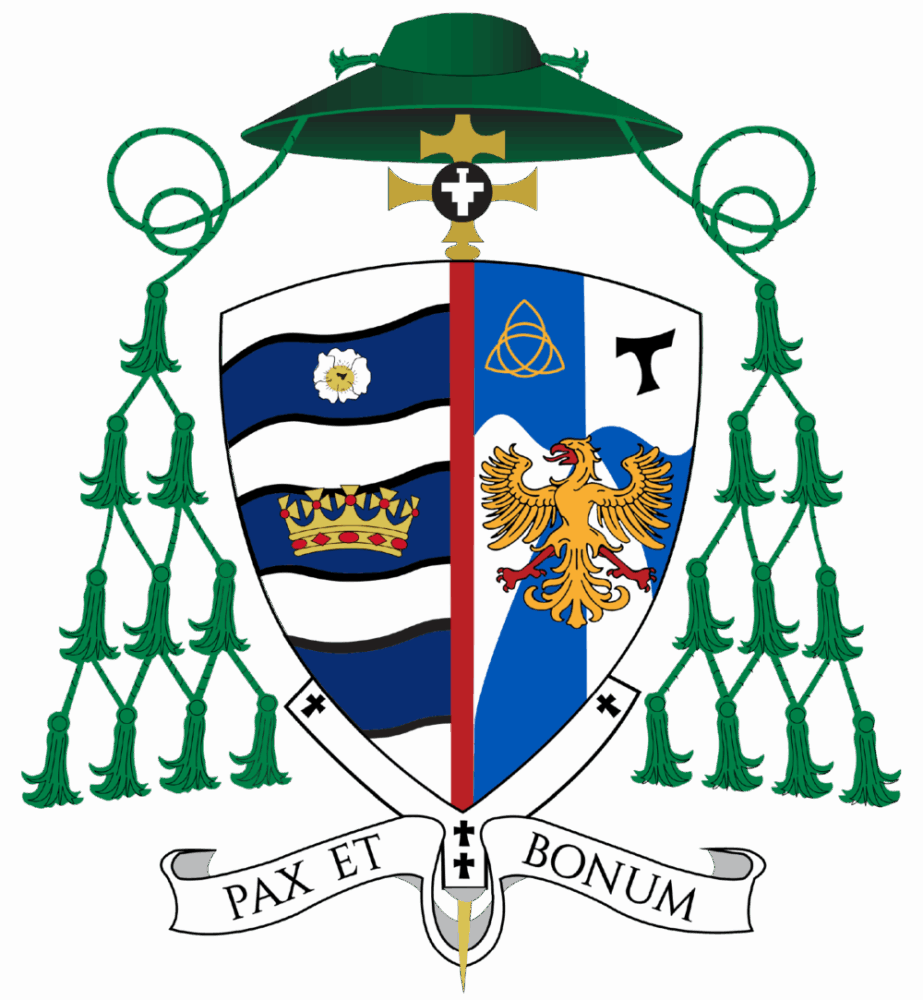
The Episcopal heraldic achievement, or bishop’s coat of arms, is composed of a shield, with its charges, a motto scroll, and the external ornaments indicating office.
The shield is explained (in heraldic terms, blazoned) in twelfth century language and articulated as if it is being given to the bearer who will wear it on his arm. Thus, it must be remembered where the terms dexter (right) and sinister (left) are used, they are in fact, reversed as one view the shield from the front.
It is Church tradition that when a bishop becomes the Ordinary of a Diocese, the arms of his jurisdiction are joined (impaled) with his personal coat of arms. The coat of arms of the Archdiocese of Atlanta appears in the dexter impalement (left side for the viewer) while that of Archbishop Hartmayer appears in sinister (right side for the viewer). This custom of combining the two is meant to show the spiritual unity shared between the bishop as shepherd and the diocese as his flock – so core to the theology of being a bishop – that he also wears a ring on his right hand as a symbol of this union.
Archbishop Hartmayer’s original coat of arms as well as this updated one was created by his former student, Brian Taberski.
The Coat of Arms for Archbishop Hartmayer
The personal Coat of Arms of Archbishop Hartmayer is intended to represent his heritage and vocation as a Conventual Franciscan Friar.
The background of wavy blue and white is a heraldic symbol for water. The archbishop is a native of Buffalo, NY – the Queen City of the Great Lakes. Water is also the key symbol of baptism – the first sacrament of initiation as a Christian. This helps recall the archbishop’s ministry as the primary sacramental minister of his diocese.
The eagle serves as a two-fold symbol of both the archbishop’s German heritage and of St. John the Evangelist. The archbishop’s father was named John, which is also his middle name.
The Celtic Knot, known as a Triquetra, represents the archbishop’s Irish heritage on his maternal side.
And finally, the Tau is a reference to Bishop Hartmayer’s vocation as a Conventual Franciscan Friar. St. Francis would sign his writing with a Tau, often painted it on the walls and doors of places and he stayed, and would remind his friars that their habit was in the shape of a Tau cross illustrating to them that they must go into the world wearing this cross like an incarnation of Christ.
Motto
Pax et Bonum – Peace and Good – are the words that were used by St. Francis in his greetings to others. It embodied the simplicity and goodness he saw in all of God’s Creation.
Blazon
Impaled fimbriated gules, at dexter (for Atlanta), Bary wavy of seven Argent and Azure; at the centre point overall an open crown Or and at the honour point a rose of the first with a center of the last, and at sinister (for Archbishop Hartmayer), per pale argent and azure a chief wavy of one crest depressed in the center of one point and issuant in base throughout a pile reversed enarched all counterchanged, overall an eagle or and in chief at dexter a triquetra interlaced with circle of the last and at sinister a tau cross sable.
From the Archdiocesan Coat of Arms
Its significance comes from symbols that uniquely represent the Archdiocese of Atlanta. The sinister, or left side, as viewed by the one bearing the shield, contains symbols representing the individual archbishop.
On the dexter for the archdiocese are three blue wavy bars that divide the shield into seven alternate wavy spaces of white and blue. In the center of the shield is an open gold crown and above on the upper wavy bar is a Cherokee rose.
The seven white and blue bars are the heraldic equivalent of the sea and represent Atlanta, which is the See City and indirectly named after the Atlantic Ocean. The seven bars also recall the seven sacraments administered in the archdiocese. Blue and white are the colors of the Blessed Mother. The wavy aspects of the bars also symbolize the rolling foothills of the Blue Ridge country of north Georgia.
The open gold crown represents the crown of Christ the King, the title of the Cathedral Church of the diocese. It may also have a secondary representation commemorating King George II of England after whom the state of Georgia was named. The Cherokee rose is the state flower of Georgia.
Pontifical Hat
Surrounding the shield and processional cross is the pontifical hat called the “galero,” with its ten tassels in four rows, on either side of the shield, all in green.
These are the heraldic insignia of a prelate of the rank of archbishop by instruction of The Holy See of March 31, 1969. Before 1870, the pontifical hat, known as a galero, was worn at solemn cavalcades held in conjunction with papal ceremonies. The color of the hat and the number of tassels were signs of the rank of the prelate, a custom still preserved in ecclesiastical heraldry.
Processional Cross
Behind the arms is placed a gold processional cross – the symbol of the Episcopal office. For the processional cross, Bishop Hartmayer has selected the Cross of San Damiano.
The entire Franciscan movement began when St. Francis, whilst praying at the Chapel of San Damiano, heard the crucifix speak to him and say, “Francis, go rebuild my Church for it is falling to ruins.”
St. Francis thought this was a literal command to rebuild the chapel that was in disrepair. Soon, however, he realized God was asking more of him. Beneath the arms, a pallium symbolizes the office of the archbishop.
